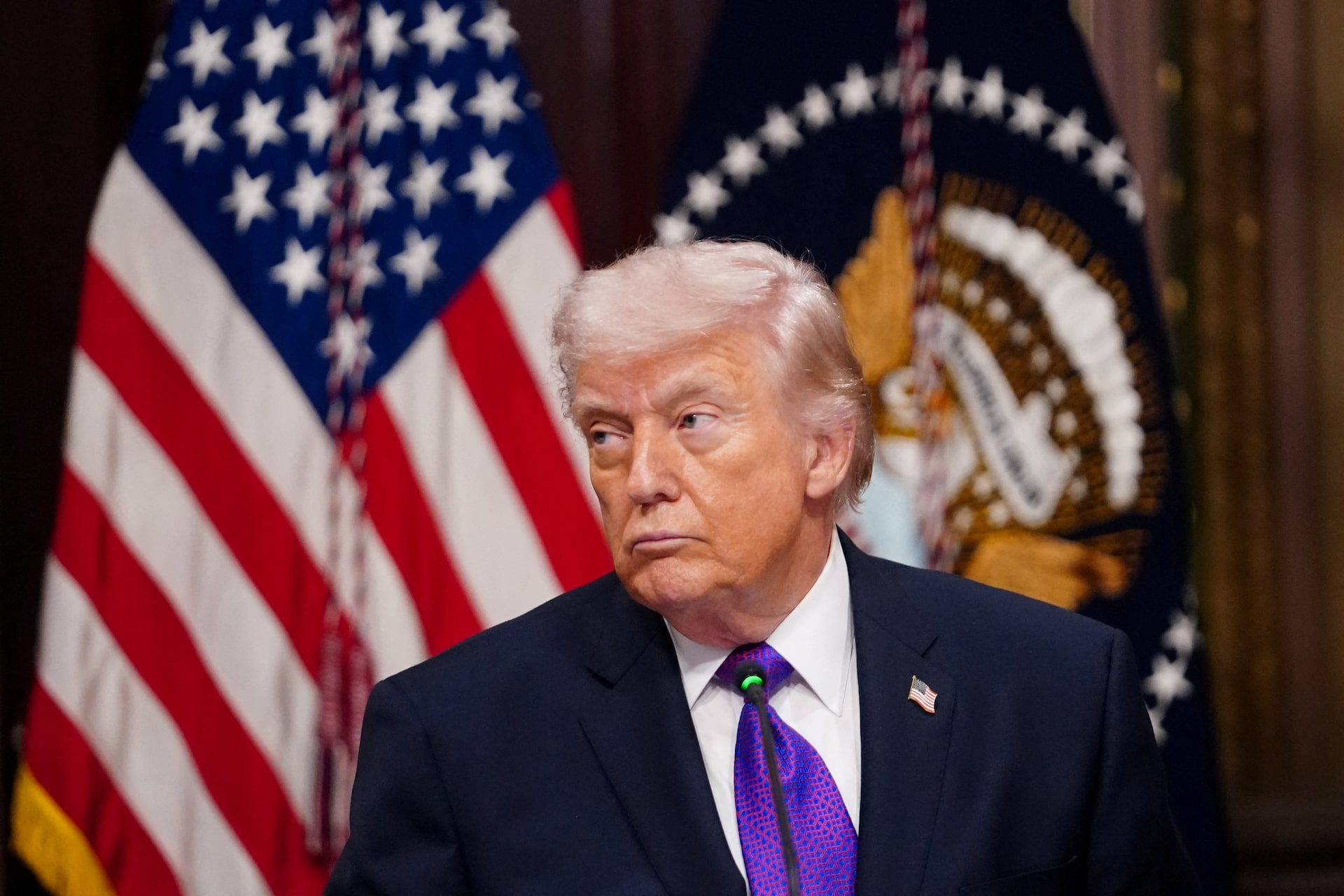
In the latest twist of international political theatre, former U.S. President Donald Trump has reportedly suggested that he should be personally involved in determining who leads Iran. The remarks, delivered during a speech addressing the escalating tensions in the Middle East, have quickly ignited global debate, part diplomacy, part disbelief, and part the sort of geopolitical commentary that leaves analysts wondering if they should update their textbooks or simply reach for popcorn.
Speaking about the ongoing conflict and the future stability of the region, Trump reportedly argued that the leadership of Iran would need to change in order for long-term peace to emerge. What caught many listeners off guard, however, was the suggestion that the United States, specifically himself, should play a direct role in selecting or influencing who might govern the country next. In the realm of international diplomacy, where even the smallest wording can spark headlines, this particular idea landed with the subtlety of a marching band in a library.
The statement arrives during a period of heightened regional tension, where military confrontations, diplomatic standoffs, and rapid political shifts have placed the Middle East at the center of global attention. In such an environment, leadership questions are not unusual. Discussions about political reform, regime stability, and the future direction of Iran have circulated among policymakers for decades. What is unusual, however, is the suggestion that leadership choices could involve outside figures in such a personal and direct manner.
To many political observers, the proposal reflects a continuation of Trump’s unconventional approach to international affairs. Throughout his political career, Trump has often favored bold declarations that cut through traditional diplomatic language. Supporters argue that this style represents decisive leadership and a willingness to challenge long-standing norms. Critics, on the other hand, suggest it sometimes resembles the foreign policy equivalent of rearranging another country’s furniture without first asking for the house keys.
Historically, the question of foreign involvement in Iran’s leadership is a deeply sensitive one. The country’s modern political identity has been shaped in part by its resistance to external interference, particularly from Western powers. Any suggestion that outside governments might influence the selection of Iranian leaders is therefore likely to provoke strong reactions within Iran as well as across the broader international community.
Diplomats and regional analysts have been quick to emphasize that leadership changes within sovereign nations typically occur through internal political processes, rather than external appointments. While international actors may influence events through sanctions, diplomacy, or negotiations, the idea of directly choosing another country’s leadership is not a standard feature of modern statecraft. Even in the often unpredictable arena of geopolitics, it tends to raise a few eyebrows, and possibly several United Nations briefings.
Reactions to Trump’s remarks have varied widely. Some supporters argue that strong leadership in Iran is necessary to stabilize the region and that international involvement could theoretically help facilitate reforms. Others view the suggestion as unrealistic, noting that political transitions in the Middle East are rarely as straightforward as selecting a new CEO for a multinational company. In global politics, leadership transitions tend to involve complex social movements, power structures, and historical grievances that resist quick solutions.
Iranian officials have not formally responded to the reported remarks, but analysts expect any such proposal would likely be rejected outright. The country’s political establishment has long framed its governance as a matter of national sovereignty and independence. The idea of external figures influencing leadership choices would almost certainly be portrayed domestically as an unacceptable intrusion.
International observers are also watching closely for the broader diplomatic implications. Statements that challenge norms around sovereignty can complicate already delicate negotiations, particularly during periods of military tension. In diplomacy, words often function like chess moves: once made, they shape the board whether or not they were intended to start a game.
Beyond the immediate political reactions, the moment also highlights the increasingly theatrical nature of modern geopolitics. In a world where speeches are livestreamed, clipped into viral videos, and debated across social media within minutes, a single statement can generate a global conversation before the applause in the room has even faded.
For political analysts, the episode underscores a familiar reality: rhetoric in international politics often serves multiple purposes. It can signal policy intentions, rally supporters, test public reaction, or simply command attention in a crowded media landscape. Whether Trump’s remarks were intended as a serious policy suggestion or as a rhetorical flourish remains a matter of interpretation.
What is certain, however, is that the comment has added yet another unexpected chapter to an already turbulent geopolitical moment. And if the notion of personally selecting another country’s leadership seems unusually ambitious, it may simply reflect the current era of politics, where even the most complex international questions can sometimes sound, at least briefly, like they’re being discussed at a very high-stakes casting call.
For now, the future leadership of Iran remains firmly within Iran itself. But in the ever-unpredictable world of global politics, even hypothetical proposals can generate real conversations; and occasionally a few bemused smiles from diplomats who have seen nearly everything, but perhaps not quite everything yet.
Leave a Reply