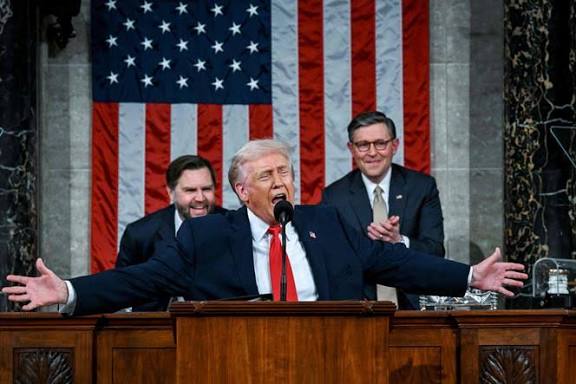
In his most recent State of the Union Address, President Donald Trump once again proudly touted his hard-nosed trade policies. This time, the spotlight wasn’t on a trade deal with a new partner or a tariff hike; it was on his bold assertion that foreign countries; not Americans, would foot the bill for U.S. tariffs. And perhaps as an encore, he suggested these tariffs might even replace the U.S. income tax. That’s a dramatic leap, but it’s worth unpacking what that claim means; and what economic reality actually says.
Let’s begin with the statement itself: in his address, Trump claimed tariffs “paid for by foreign countries … will, like in the past, substantially replace the modern-day system of income tax, taking a great financial burden off the people that I love.” It’s the kind of rhetoric that would make any headline writer salivate; and economists wince.
At face value, the idea seems simple: slap tariffs on imported goods, and foreign manufacturers cough up money into the U.S. Treasury. Then you don’t need income taxes. Who needs progressive tax brackets when you have countries like China, Japan, and the EU lining up to pay trillions? Dream scenario for the policy team; nightmarish logic for, well, everyone else.
Unfortunately for that dream, it isn’t how the economics toolkit actually works. Tariffs are, in technical terms, a tax on imports. But they aren’t a tax on the exporting country. By design, they’re collected at the U.S. border by U.S. Customs and Border Protection from the importer; which, in most cases, is an American company bringing goods into the United States. The foreign producer doesn’t cut a check to the Treasury. Ever.
Economists make a standard distinction between statutory incidence and economic incidence. Statutorily, the importer is on the hook. Economically, the real burden can be shared between the exporter, the importer, and the final consumer depending on pricing, demand, and supply. But in most real-world scenarios; and according to multiple data analyses; the vast majority of the tariff cost lands on U.S. businesses and consumers. Some studies have found that roughly 90 – 96 % of Trump-era tariff costs are absorbed domestically, with only a tiny sliver effectively “borne” by foreign exporters who cut their prices slightly in response to the tariff.
To put it in human terms: if U.S. consumers are buying Chinese sneakers at the U.S.–China tariff rate, the tariff doesn’t make the Chinese manufacturer send extra revenue to Washington. Instead, the price at which the shoes are sold to U.S. importers goes up; either through markups or raised retailer prices; and American households carry the bulk of the cost. That’s no mystery; it’s economics 101.
Yet the political narrative is simpler; and more appealing to some constituencies. A tariff that is “paid by foreigners” sounds like a free lunch: foreign governments foot the bill, tariffs fill the Treasury, taxes go down. Who wouldn’t want that? It’s the fiscal equivalent of saying you can eat unlimited pizza and still lose weight if you just believe hard enough.
The problem; beyond the physics-defying economics, is that even if tariffs did bring in significant revenue, they raise very little compared to existing income taxes. U.S. income taxes are the government’s bread and butter: trillions of dollars flow into the Treasury every year from individual and corporate income taxes. By contrast, even ambitious tariff plans, let alone ones partly rolled back by court rulings, generate only a fraction of that revenue potential. In fact, some economic analyses suggest tariffs might only make up a few percentage points at best of what income taxes do in a typical fiscal cycle.
There’s also an additional wrinkle: high tariffs can suppress trade. Tariffs can make imported goods more expensive, which might protect some domestic producers, but those higher prices often get passed on to consumers. In response, U.S. businesses reliant on imported inputs may see higher costs, which can dampen investment, slow growth, and in some cases lead to job losses in industries that depend on global supply chains. Elevated tariffs also risk retaliation, escalating trade tensions that can feed inflation or hurt exports.
So when Trump insists that “countries are now paying us hundreds of millions” or that tariffs will “replace” income tax, you have to read that political rhetoric with an economic grain of salt, and perhaps a whole salt shaker. It’s the sort of bravado that sounds appealing in a speech bubble above a cartoon character, but less convincing under the steady analytical gaze of economists who actually model who pays what.
It’s also worth mentioning a recent wrinkle: parts of Trump’s tariff regime were struck down by the U.S. Supreme Court as exceeding presidential authority under certain statutes. Though not all tariffs were affected, the legal hits create another layer of complexity, weakening the reach of some of the most sweeping levies he had put in place.
The bottom line? While it’s politically expedient to frame tariffs as a burden borne by foreign powers, real economics, and real bills at checkout counters, tell a different story. Tariffs often act more like a consumption tax on Americans than a payment from abroad. And as a replacement for income tax? Even in the most optimistic Trump-style permutations, that remains more political slogan than economic blueprint.
Leave a Reply